


What kind of contractor website are you buying?
A fence installer with a busy Facebook page needs something different from a roofing company connecting quote requests, advertising, and office follow-up. Before asking how much a small business website costs, write down the job it needs to do. These are the three scopes I would separate.
01 / Establish credibility
A clear business website
Explain the work, show real projects, name the service area, and make it easy to call. A focused starting point for a business that already gets referrals.
02 / Capture inquiries
A website with follow-up
Add useful quote questions, reliable notifications, a receipt confirmation, and a clear person responsible for responding. This is more than putting a form on a page.
03 / Grow acquisition
A site plus marketing
Add an agreed program for search visibility, content, or paid campaigns. Define the extra work, budget, and reporting separately from hosting and maintenance.
None of those is automatically the right choice. My recommendation is to buy the smallest complete system that fits the jobs you want, your current sources of attention, and your ability to respond.
Contractor website pricing: add up the whole year
Use the same time period when comparing quotes. A low monthly number is not the whole cost if a setup fee, required software, writing, or support sits outside it.
Your comparison formula
Setup + 12 monthly payments + required extras
Then list optional marketing and advertising separately.
Here is a real, dated example from Tin Roof’s trades website offer, as published on October 8, 2026. The full-year calculation assumes the service continues for all 12 months; the offer has its own 90-day guarantee and cancellation terms.
- One-time setup
- $1,000
- 12 months at $299
- $3,588
- Full first-year base fees
- $4,588
No advertising spend included. Read the current offer and full terms before deciding; this calculation does not replace them.
The published scope includes a four-to-five-page website, a trade-specific quote form, inquiry notifications and acknowledgments, Google Business Profile cleanup, hosting, updates, and a monthly inquiry summary (offer details). A larger site, additional integrations, ongoing SEO, or paid-ad management needs its own written scope; do not assume every marketing service is bundled into a maintenance payment.
Ask the same questions of a one-time project quote: who hosts it afterward, who makes changes, what software remains payable, and what happens when the form stops reaching the right person? A quote is useful only when you can tell what you will own and what you will still need to manage.
What should contractor website design include?
I would evaluate these items before debating animations, page count, or how many stock photos come with the package. Each one should have a concrete deliverable and a launch check.
Clear services and a truthful service area
Name the work you want to win, what fits, and where you actually travel. Give distinct services useful explanations instead of copying the same paragraph into dozens of city pages.
Your work, not someone else’s stock portfolio
Use approved job photos, short project descriptions, and genuine reviews with attribution. Confirm who writes the copy, selects the photos, and gets permission for identifiable customer details.
A mobile contact path that gets checked
Make the phone number tappable and the estimate form readable on a phone. Ask enough to route the job, then check receipt, notifications, and the customer’s confirmation before launch.
Search basics and safe URL handling
Specify page titles, descriptions, useful internal links, indexability checks, and accurate structured data. For a redesign, document existing URLs and preserve them or map necessary redirects.
Ownership, support, and a useful handoff
Put domain ownership, website access, recurring fees, content updates, and cancellation terms in writing. Name the person who fixes a problem and explain what transfers if you leave.
That is the starting point for our contractor website design work. A project map, custom quote tool, booking workflow, or production shoot can be valuable, but I would price it against a specific business need rather than add it simply because it looks impressive.
Two real contractor examples: why scope changes the price
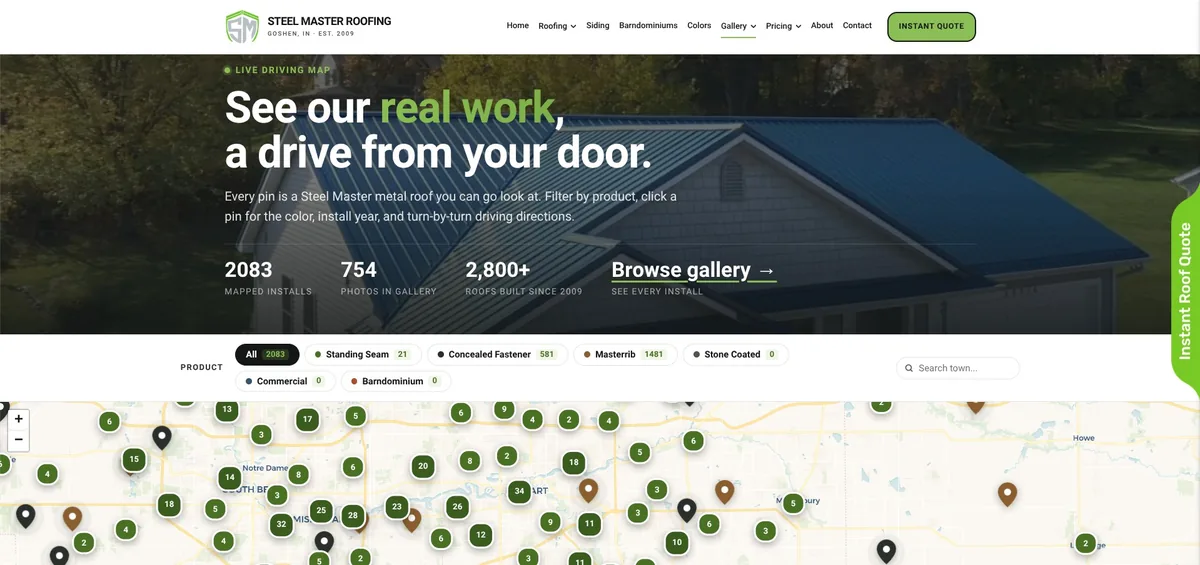
A roofing business with quote requests and office follow-up
For a metal roofing company in Goshen, Indiana, the published engagement includes a website, quote pathways, paid media, local-search work, lead records, follow-up, original content, and an interactive project map (roofing case study). That is a broader engagement than a basic website, so its scope should not be treated as the contents of a smaller monthly package.
The lesson I take from that work is to price the handoffs as well as the pages. Who receives the request, who follows up, and how does the office distinguish a requested time from a confirmed appointment? Explore the client’s site at Steel Master Roofing.
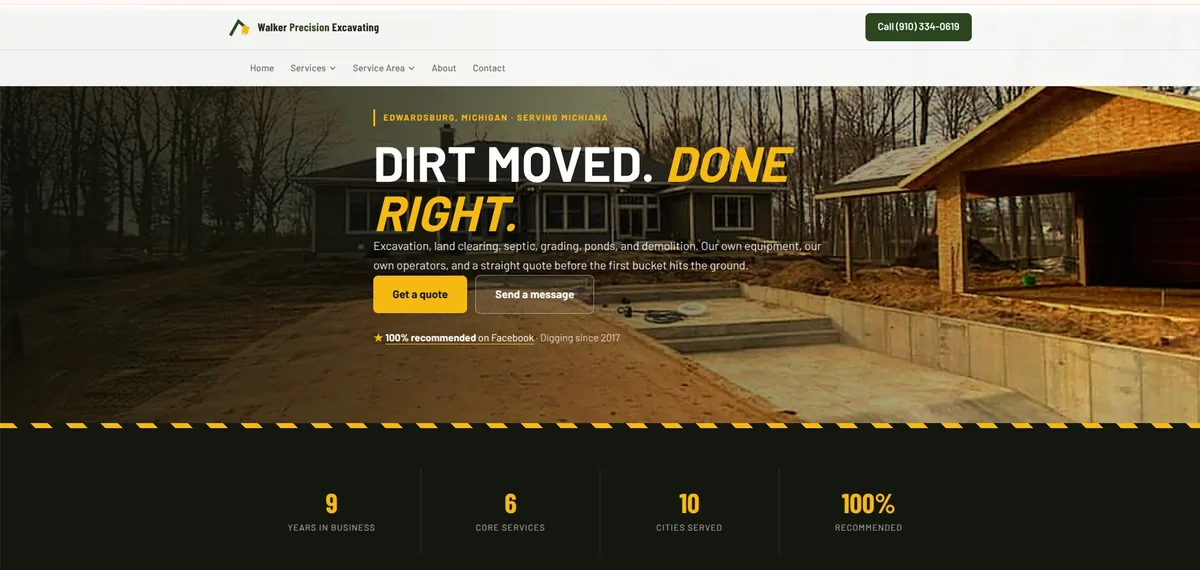
An excavation business with several different job types
A contractor in Constantine, Michigan lists excavation and site preparation, land clearing, septic installation, grading, pond construction, and demolition on its Walker Precision Excavating website. For that mix, I would prioritize clear service explanations and job-site proof so a homeowner or builder can identify the relevant work before contacting the company.
That is why page count alone is a weak buying test. Five carefully scoped pages may suit one business, while another needs more detail because its services, customers, and inquiry requirements are genuinely different.
Does the website price include SEO, AI visibility, and Google Ads?
Ask the provider to separate launch essentials from ongoing work. My recommended launch scope includes readable content, search-friendly page structure, crawlability checks, and an accurate description of the business; ongoing SEO should describe what will actually be improved after launch.
Unpaid discovery
SEO is a work plan.
Ask which service pages, local information, project content, and technical issues will be addressed, and how progress will be reviewed.
See contractor SEO servicesPaid acquisition
Ads need their own budget.
Separate platform spend from campaign management and landing-page work. Agree on territory, service focus, and lead measurement before launch.
See paid advertising servicesFor AI search, Google says the existing SEO fundamentals still apply, including crawlable pages, internal links, important information in text, and structured data that matches visible content; there is no special AI schema requirement or guarantee of inclusion (Google’s AI features guidance). I would ask what useful content and technical work a provider will deliver rather than pay for an unexplained “AI-ready” label.
If you are deciding between channels, read SEO vs. Google Ads for contractors. Keep the website, marketing work, and media spend visible as separate decisions even when one person manages them.
How many extra jobs would make the website worthwhile?
Use the money left from a job after its direct costs, not the full invoice amount. A $2,500 job is not $2,500 available to pay for marketing once materials, labor, subcontractors, and other job costs are covered.
I would also record whether the inquiry came from a referral, organic search, a Facebook link, or a paid campaign where that information is available. Do not call every job a website-generated sale simply because the customer visited the site.
Before you sign: a seven-question website quote checklist
- What is the full first-year cost, including setup, required subscriptions, and maintenance?
- Which pages, writing, photos, and revision rounds are included?
- Who owns the domain, content, site files, and connected accounts?
- What happens after a quote request, and who verifies the notification reaches us?
- Which existing URLs and tracking will be preserved if this replaces our site?
- What does the monthly fee cover, and what is billed separately?
- What happens if we cancel, miss a payment, or want another provider to maintain the site?
Get those answers in the proposal, not just on a call. A clear scope makes it easier to choose a provider and easier for both sides to know when the job is complete.
Common questions about contractor website costs
Is a monthly contractor website plan better than paying once?
Neither structure is automatically better. Compare total cost over the same period, ownership, required support, and cancellation terms. I would choose the plan that matches how much ongoing help the business actually needs.
Do I need a website if I already have Facebook and Google reviews?
My recommendation is to give that attention a clear destination where people can see your services, check your territory, review your work, and request an estimate. Keep Facebook and reviews; build the site around the gaps they leave in your current inquiry process.
Can Tin Roof build a contractor website outside Michigan?
Yes. Our trades website offer is available nationwide and is built remotely using your business information and project photos. On-site video or photography is a separate scope, not something to assume is included in a nationwide website package.
Does paying more guarantee more leads?
No. I would judge the scope against your business needs and then track relevant inquiries and outcomes. A website still needs the right visitors, a clear offer, available capacity, and someone who follows up.
Get a clear starting point
Before you buy another website, know what you actually need.
Already have a site? Send it over for a free, personal report card with three priority fixes. I will email it within one business day, without requiring account access or a sales call.
Get my free website report card
Starting with just Facebook and reviews? See the nationwide trades website offer, including the current price, scope, and guarantee terms.
Written by Sam Harrington, founder of Tin Roof Digital. Pricing example checked October 8, 2026. Examples illustrate scope, not guaranteed rankings or customer results.